you are already enough, just sit…

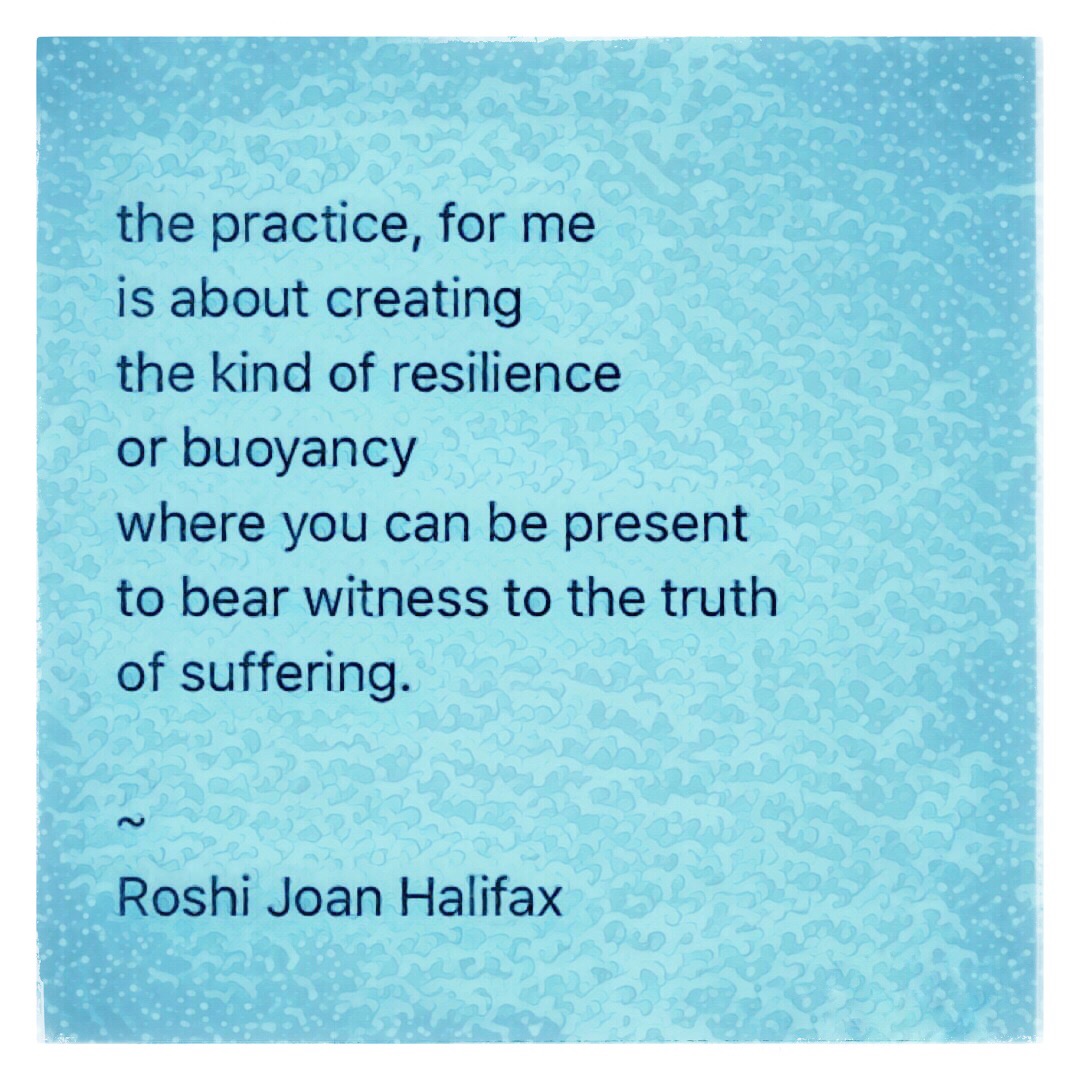
“The essence of Buddhist practice is not so much an effort at changing your thoughts or your behavior so that you can become a better person, but in realizing that no matter what you might think about the circumstances that define your life, you’re already good, whole, and complete. It’s about recognizing the inherent potential of your mind. 
In other words, Buddhism is not so much concerned with getting well as with recognizing that you are, right here, right now, as whole, as good, as essentially well as you could ever hope to be.”
~

Yongey Mingyur Rinpoche

self-care and care for others in dark times…

jmw-meditating


Recently I wrote that the world is in need of heroes, spiritual warriors, and bodhisattvas.

Given the state of things, especially in recent weeks, it appears that WE must be the heroes, the spiritual warriors, and bodhisattvas that we seek and that the world needs.  We cannot wait, as most of us have done in the past, for spiritual or secular leaders to rise up and rally, to galvanize and gather on our behalf.

This is a good thing!  It is incredibly inspirational to see hundreds of thousands, and in some cases millions, of people around the globe standing up for the oppressed, the marginalize, and the most vulnerable – speaking truth to power with words and actions alike.

There has been a call.  Have you felt it?  The misdeeds and harmful actions of those in power has brought forth, for many, an almost instinctual – from the bones – reaction to resist and work towards an alternative.  And it does seem that what we have perhaps taken for granted in the past, cannot be taken for granted any more, but must be worked for and served.

People are in need and suffering.  We can offer ourselves – our talents, our skills, our words, our hands and feet, and our hearts – in service to relieving and healing that suffering.  This is what many Buddhists participate in, the Bodhisattva Vow, “Sentient beings are numberless; I vow to save them all.”  Of course we cannot save anyone, much less everyone, but within this vow is the recognition of self-lessness, of interdependence – the idea that I am because you are and what happens to you also affects me.  So, meditate on the softness of our heart, the tenderness that rises up when we think of a loved one, of someone dear.  We then extend this good will that has arisen toward others, knowing that they are someone’s loved one and they too are dear to someone.

None of us escape this journey unscathed by pain and suffering.  We all will experience illness, aging, loss, and eventually that great mystery that is death.  Isn’t this enough to draw out empathy and find common ground and open our hearts?  Our love and care when put into action is compassion…and in the current state of things we need some FIERCE compassion.  If we want our cause to be successful, we cannot be consistently motivated by anger.  We will burn out and burn everything else with us.  Our motivation MUST come from a place of love and fierce compassion working towards the noble causes of justice and peace.

There has been a lot of fierce compassion lately.  I saw it at the Women’s March and I’ve seen it in subsequent marches and peaceful protests as people stand, walk, and speak in the footsteps and voices of heroes, spiritual warriors, and bodhisattvas.

This can be and has been EXHAUSTING.  And when we are exhausted and diminished, we can get angry, irritable and then our words and actions may move from being beneficial to harmful.  Ends do not justify means.  The means are the end.  We must be what we seek.

So, how can we put that fierce compassion into action, if we are diminished, if we are exhausted?

When we take a bodhisattva vow, or make any commitment to serve others, to work towards an end to suffering, we must also include ourselves.  Self-care so that we can care for others.  This is what makes this a spiritual act.  Self-care only, is simply self-help.  This can be beneficial and good, but I am talking about something different here.  Self-care so that one can also care for others is a spiritual practice (even if you are agnostic, humanist, or atheist – no need to belong to a specific religion or belief system).  We practice as a benefit to ourselves and others, to reduce suffering in the world – even for those who are supposed “enemies” who may be on the opposite side of issues, even seeking our harm to support their desire to be “safe.”  Of course, none of us are safe if any community or group of people are scapegoated as “other.”  To paraphrase a quote by Diana Winston, “…there is a big difference between loving our enemies (those who’d harm us or others) and letting them get away with their wrongdoing (harmful actions).”  [additions mine ~j]

As a Buddhist (though one does NOT need to be Buddhist), as a meditator for the past 9 years, and as a meditation instructor I suggest and stand behind (…or is it sit behind) a regular meditation practice, as a beneficial support to self-care, so that one can also care for others.

A friend of mine recently asked me to share information about meditation practice with others in a post, because she has seen what many of us have seen – people exhausted and diminished by a deluge of negativity and overwhelming changes from those in power, pulling the ground out from under us.  She felt it would be a benefit and I do as well.

A note regarding meditation practice.  It isn’t a quick fix.  This may be disappointing, but the goal isn’t to attain some blissful or peaceful state (but what’s wrong with that?!).  When we practice meditation, we are practicing to be present in this moment – our mind and body together in one place – no matter the situation or what we are feeling.  In this way, with consistent practice, our hearts begin to naturally open and build a capacity to be with life as it is, without immediately reacting to it.  We are making space and in that space, we have the ability to choose our words and actions thereby benefitting the world, rather than adding to its suffering.  A short period of sitting every day is more beneficial than a long period of sitting once a week.  Don’t be discouraged.  After 9 years of meditating, I have noticed growth in my capacity to be with life and have seen my heart open more and more.  I wouldn’t have sought out instruction to be a teacher, if this weren’t the case.  And it is humbling, because other than committing to sitting and breathing, I have done nothing else to make this happen.  This is a nod to our true nature, which I believe is essentially good, that when we simply sit and allow the noise to fall away, to arise and then pass, the goodness of our hearts eventually comes forth.

I have recorded a brief 10-minute guided meditation as an introduction and instruction for you.

If you are new to meditation, I would also like to suggest my teacher’s book:  Start Here Now: An Open-Hearted Guide to the Path and Practice of Meditation by Susan Piver.
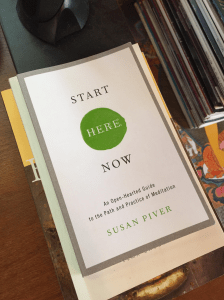
start-here-now

You may also want to connect with her teaching and instruction online at The Open Heart Project.

If you are interested in further exploration of the intersection of contemplative practice and social action/service, I’d also like to suggest The Road Home: A Contemporary Exploration of the Buddhist Path by Ethan Nichtern, who is also a teacher I admire and follow.  The last few chapters explore this more deeply.
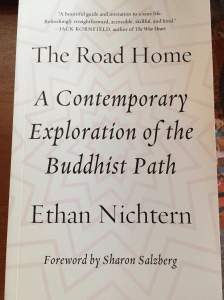
the-road-home

Ethan has also written a wonderful 7-Point Practice Plan for Engaged Mindfulness to assist in self-care as we care for others in this difficult time.

Wishing you all well as we journey together.

May all beings be happy and at ease.
May all beings be free from suffering.


~ j

01.30.17


forward, breath by breath…

Prior to the Christmas holiday, a dear friend reached out and commissioned some ensos.  These were to be particular ensos incorporating a semicolon, which was brought into focus as a simple of hope and journeying forward through the semicolon movement / Project Semicolon.

Here is a photo of one of the ensos I painted below, with an explanation of each element (the enso, the semicolon, and the phrase placed with it):


In Zen, the enso is a circle that is usually painted in one brushstroke, sometimes two, to express a moment when the mind is free to let the body create. It is considered abstract minimalist fine art. The enso is not about creating a “perfect” piece of art, rather the purpose is to authentically express “this” moment. The enso can symbolize our journey, the universe, enlightenment, awakening, life, and what I like to call “perfect imperfection.”


The semicolon (as expressed by Project Semicolon), “…is to restore hope and confidence in people who are troubled by addiction, depression, self-harm, and suicide. The semicolon symbolizes that the difficulties they face are not the end but a new beginning. A semicolon is used when an author could’ve chosen to end their sentence, but chose not to. The author is you and the sentence is your life.”


The mantra/phrase, “It’s just one breath”, is a phrase I’ve heard the meditation and Buddhist teacher Sharon Salzberg use often.  I have often incorporated this mantra into my meditation practice from time to time. When life or situations can feel overwhelming, it can be a wonderful salve to bring oneself back to this present moment, one breath at a time, remembering that “it’s just one breath.”  I thought this phrase made for a beneficial pairing with the semicolon and the enso.


~j


*Please note: Although meditation can be a beneficial and fruitful companion to professional medical or therapeutic help, it is not a substitution for these in the case of severe or clinical depression. It is best to seek professional advice when incorporating a meditation practice.

Practicing Dharma in Uncertain Times…

Wonderful essay by the incomparable Jack Kornfield. I have copied this from Lion’s Roar publication, but the essay originally posted at the Spirit Rock website.

May his words open eyes and hearts.
~j

Now Is the Time to Stand Up: Practicing the Dharma in Uncertain Times, Part 2

After the election of Donald Trump, Lion’s Roar shared a new teaching by Jack Kornfield, called “Practicing the Dharma Uncertain Times.” Now, Jack follows up with second, more action-oriented installment of post-election guidance and encouragement.

Ordained tree.

As long as a society holds regular and frequent assemblies, meeting in harmony
and mutual respect, can they be expected to prosper and not decline.
As long as a society follows the long held traditions of wisdom, and honors its elders,
can they be expected to prosper and not decline.
As long as a society protects the wives and daughters and vulnerable among them,
can they be expected to prosper and not decline.
As long as a society cares for the shrines and sacred places of the natural world,
can they be expected to prosper and not decline.
—Mahaparinirvana Sutta (a text of Buddha’s last teachings)

Whatever your political perspective, now is the season to stand up for what matters. To stand against hate. To stand for respect. To stand for protection of the vulnerable. To care for the natural world.

Do not believe that meditation and contemplation are the fulfillment of the Buddhist Path. Inner peace, freedom and joy develop only when paired with the outer teachings of virtue, respect and mutual care. The foundation of Dharma is relational, built on generosity, virtue and loving-kindness. The Path to human happiness and liberation requires Right Intention, intentions that are free from greed, hatred and cruelty; Right Speech, speech that is true and helpful, not harsh, not vain, slanderous nor abusive; and Right Action, actions that are free from causing harm, killing, stealing and sexual exploitation.

In his life, the Buddha intervened to try to stop wars. He counseled kings and ministers, and guided those around him with teachings of peace and respect. In modern times, Maha Ghosananda of Cambodia joined the United Nations peace process and led years of peace walks of loving-kindness through the war zones and killing fields of Cambodia. Thai abbots have taken their robes and ordained the oldest trees as elders of the forest to protect whole ecosystems from logging. Burmese monks and nuns marched in the streets to protect citizens from the harsh military dictatorship. A.T. Ariyaratne in Sri Lanka enlisted hundreds of thousands in a 500-year peace plan. Vietnamese, Chinese and Tibetan monastics have stood up for peace, justice and compassion, even immolating themselves to stop the harmful actions around them.

Gandhi explains, “Those who say spirituality has nothing to do with politics do not know what spirituality really means.”

This is not about red or blue. It is about standing up for the most basic of human principles, for moral action and the prevention of harm. It is embodying Dharma amidst the troubles of the world.

You are not alone. You have generations of ancestors at your back. You have the blessing of interdependence and community. You have the great trees of the forest as steadfast allies. You have the turning of the seasons and the renewal of life as your music. You have the vast sky of emptiness to hold all things graciously.

With peacefulness and mutual respect, our Buddhist communities can become centers of protection and vision.

You have been training for this for a long time. With practice you have learned to quiet the mind and open the heart. You have learned emptiness and interdependence. Now it is time to step forward, bringing your equanimity and courage, wisdom and compassion to the world. The Bodhisattva shows the way to alleviate suffering amidst it all.

As Zen master Thich Nhat Hanh explains, “When the crowded Vietnamese refugee boats met with storms or pirates, if everyone panicked all would be lost. But if even one person on the boat remained calm and centered, it was enough. It showed the way for everyone to survive.”

Since the election, storms of uncertainty and fear have arisen. It is time to collectively stand up, calm and clear. With peacefulness and mutual respect, our Buddhist communities can become centers of protection and vision.

Protection can take many forms. Protection can be providing sanctuary for those in danger. Protection can be skillfully confronting those whose actions would harm the vulnerable among us. Protection can be standing up for the environment. Protection can be becoming an active ally for those targeted by hate and prejudice.

Vision means carrying the lamp of the Dharma. It means standing up for the truth—no matter what:

“Hatred never ceases by hatred, but by love alone is healed.”
“Greed, Hate and Ignorance create suffering. Generosity, Love and Wisdom bring happiness.”
“Mind is the forerunner. Speak and act with a pure mind and happiness will follow.”
“Plant seeds of goodness, and well-being will grow.”

Now a time of change has come.

We must listen deeply, bear witness, honor everyone, and choose our actions wisely and courageously.

Do not worry if the Right Action is not yet clear to you.

Wait in the unknowing with mindfulness and a clear heart.

Soon the right time will come and you will know to stand up.

I will meet you there.


This piece was originally published on SpiritRock.org.


Jack Kornfield is a founding teacher of the Insight Meditation Society and Spirit Rock Center and one of the key teachers to introduce Buddhist mindfulness practice to the West. He is a former Buddhist monk, a clinical psychologist, and a husband and father.

sharing the practice…


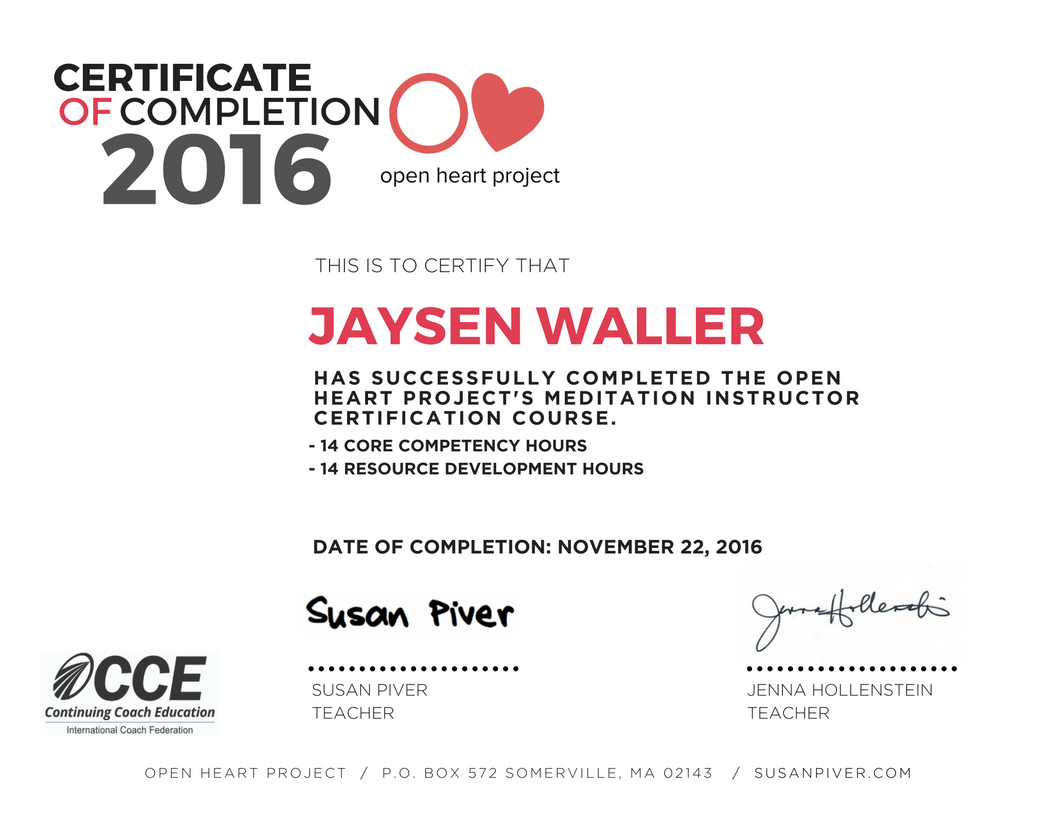
In 2008, I began a regular meditation practice after reading the book Calming The Fearful Mind: A Zen Response To Terrorism by Thich Nhat Hanh. It wasn’t that my mind was especially fearful, no more than any other person I suppose, but fear seemed and still seems to be very present in the world. And along with fear, all the other emotions that we either try to avoid, react from, or attach to. I wanted to learn to work with my mind and heart – with all of what is there, the fear, the anger, the sadness, the joy, the attachment. Although the willingness to be with what is – even if uncomfortable – is a courageous act, it also feels like a necessary act. something needed to help foster and maintain a sane balance in a beautiful world that can sometimes seem the opposite.At the beginning of 2016, with so much fear, anger, and negativity, I made a personal vow to work towards that which is healing. Part of this vow was to more fully invest in my meditation practice, devote my art and writing towards this aspiration, and to seek the path of being a teacher of meditation. An opportunity arose with a teacher I had long admired and followed, Susan Piver. Susan is from a lineage of Tibetan Buddhism, called Shambhala, which I deeply admire and respect. Though, to be clear, one does not have to be Buddhist to participate, practice, or teach meditation. The opportunity Susan was offering through her Open Heart Project, was unique and fit within where my life is presently. The practice of Shamatha (Sanskrit for “calm abiding”) has become my core daily practice and the practice I am now authorized to teach.

I cannot adequately express my gratitude or how amazing the past 9 weeks of training have been with Susan, and Jenna Hollenstein who co-taught. Their generosity of heart, the knowledge and wisdom imparted to us, and the gentleness of this practice transmitted to us has been a gift. I made friends from around the world that I will now be connected with and the practice I love and is a refuge has deepened. I am humbled, honored and grateful to share this with others. Bows of gratitude to both Susan and Jenna, along Michele Gare who was the magic behind the scenes at The Open Heart Project.
~j

shine your light…


If we keep our own light selfishly hidden, it will only provide a limited amount of illumination. But when we share our light with others, we do not diminish our own light. Rather, we increase the amount of light available to all.~Master Sheng-Yen

#light #shine #generosity #practice #compassion #kindness #bodhicitta #bodhisattva #meditation #JMWart

we practice for times like these…


This is what we’ve been practicing for: the situations where the practice doesn’t come easily. When the winds of change reach hurricane force, our inner refuge of mindfulness, concentration, and discernment is the only thing that will keep us from getting blown away. 
~

Thanissaro Bhikkhu

#practice #meditation #change #refuge #mindfulness #concentration #discernment #grounded #steady #presence #JMWart

the next step…


my reading preparation…”Start Here Now: An Open-Hearted Guide to the Path and Practice of Meditation” by Susan Piver

“Turning the Mind Into an Ally” by Sakyong Mipham

“Buddha’s Brain: The Practical Neuroscience of Happiness, Love, & Wisdom” by Rick Hanson, PH.D. with Richard Mendius, MD
…after 8 years of a personal meditation practice and seeing the benefit, in two weeks I begin a nine week course through The Open Heart Project in Shamatha (Sanskrit for “peacefully abiding”) meditation to both strengthen and grow my own practice and to become a certified meditation instructor. grateful for this opportunity and next step on the journey.
~j

09.13.16
#Shamatha #meditation #practice #Shambhala #Buddhism #TheOpenHeartProject #gratitude