stay with it…

our tendency, our pattern is to avoid our heartbreak, our fear, our discomfort at all costs.
a relationship ends, a job is lost, a loved one becomes ill, the world is spinning out of control and we react.  sometimes we grasp at the next person or possible relationship, at every little thing that promises good health.  sometimes we attack aggressively to protect ourselves. and sometimes we avoid at all costs, “ignorance is bliss.”

these ways of reacting to what makes us feel uncomfortable in life – grasping, aggression, ignorance (also sometimes called greed, hatred, and delusion) are what we call in Buddhism, the Three Poisons.  they perpetuate suffering – the very thing we are desperately trying to avoid in our patterns of reactions.  the antidote to these poisons is a broken heart, an open heart.  and the only way to give our hearts a shot at being open and opening wider – building its capacity to be with life – is to allow our hearts to break.

ugh, right?  who wants to do that?  not most of us, which is why we can look around and see ourselves and other hurt people jumping from one relationship to another, see ourselves and other hurt people trying a new fad diet or health claim one after another, see ourselves and other hurt people aggressively attacking “friends” on social media who have opposing views, or even simply wanting social media to return to cat memes and name games, because it has gotten too “political.”

but the truth is, our discomfort will not go away with the next person in our bed, or the loss of a certain number of pounds, or getting that last word in, or turning off the tv/computer and pretending the world isn’t burning.  none of these will make a difference if we can’t sit still and allow our discomfort to break open our heart, to open it, to teach us.  a broken heart, an open heart allows our love to be free.

Pema Chödrön wrote a book titled, “The Wisdom of No Escape.”  I love this little phrase.  it is counter intuitive to our habitual pattern of running away, running through, and going to war with ourselves and others.

can we see that we need not go to war?  that we are inherently strong enough, courageous enough to not only be with our pain, but to allow our love to heal it?

we must learn to sit with ourselves and our discomfort, gently and compassionately allowing our hearts to break open and our love to flow, if we want to be free.  this is our life calling us to awaken.

stay with it…

~j
03.05.17

because love calls us to…

pride-peace-art-update-2017

Despite what this Administration says, the welfare and safety of our transgender youth is not a States’ Rights issue.

It is a Human Rights issue.  Plain and simple.

Creating and supporting an environment that is safe and affirming for all of our youth, including and especially those who are marginalized and vulnerable is in the best interest of all of us as a society and only asks that we open our hearts.  It does not require our agreement, or even our full understanding.  All it asks of us is our empathy and compassion.

If you find yourself resistant to this, there is a wonderful Buddhist meditation practice called Metta, or Lovingkindness meditation.  It is a training in opening the heart.

In Metta, we begin with offering to ourselves, using the phrases:
May I be happy
May I be safe
May I be free from suffering

Then we offer to others, using the phrases:
May you be happy
May you be safe
May you be free from suffering

Offering to a loved one, then to a benefactor.  Offering to someone we may be aware of, but do not really know.  Then to someone with whom we may be in disagreement or find we have some negative feelings toward.  Then we offer to all beings, all of life.

We can surely also offer this practice to those whom we may not understand, for those who are different from us, who hold different views, who have a life experience different from ours.

Compassion is love offered and put into action out of the tenderness and softness of our hearts.  It is not something we give to only those we agree with or for whom we think merit its benefits.  It is a gift we give, simply because it is there and it is needed.  It benefits the giver as well as the recipient.

Stand with our youth, stand with our transgender family, because love calls us to do so.

~j
02.22.17


an open heart…

our practice is a practice of compassion, of opening the heart.it is a practice of allowance, allowing our heart to break open and reveal the vulnerability and tenderness that is our power and strength.

it is a practice of being with life through laughter and tears alike.
~j

a worthy experiment…

most of us live from one reaction to another reaction, ping ponging through life. what would happen if we simply just stop, if we allow ourselves the space to be still, if we just sit and breathe?  we may just find that it is a worthy experiment.

~j
*phrase in artwork inspired by Thich Nhat Hanh.

you are already enough, just sit…

“The essence of Buddhist practice is not so much an effort at changing your thoughts or your behavior so that you can become a better person, but in realizing that no matter what you might think about the circumstances that define your life, you’re already good, whole, and complete. It’s about recognizing the inherent potential of your mind. 
In other words, Buddhism is not so much concerned with getting well as with recognizing that you are, right here, right now, as whole, as good, as essentially well as you could ever hope to be.”
~

Yongey Mingyur Rinpoche

self-care and care for others in dark times…

jmw-meditating


Recently I wrote that the world is in need of heroes, spiritual warriors, and bodhisattvas.

Given the state of things, especially in recent weeks, it appears that WE must be the heroes, the spiritual warriors, and bodhisattvas that we seek and that the world needs.  We cannot wait, as most of us have done in the past, for spiritual or secular leaders to rise up and rally, to galvanize and gather on our behalf.

This is a good thing!  It is incredibly inspirational to see hundreds of thousands, and in some cases millions, of people around the globe standing up for the oppressed, the marginalize, and the most vulnerable – speaking truth to power with words and actions alike.

There has been a call.  Have you felt it?  The misdeeds and harmful actions of those in power has brought forth, for many, an almost instinctual – from the bones – reaction to resist and work towards an alternative.  And it does seem that what we have perhaps taken for granted in the past, cannot be taken for granted any more, but must be worked for and served.

People are in need and suffering.  We can offer ourselves – our talents, our skills, our words, our hands and feet, and our hearts – in service to relieving and healing that suffering.  This is what many Buddhists participate in, the Bodhisattva Vow, “Sentient beings are numberless; I vow to save them all.”  Of course we cannot save anyone, much less everyone, but within this vow is the recognition of self-lessness, of interdependence – the idea that I am because you are and what happens to you also affects me.  So, meditate on the softness of our heart, the tenderness that rises up when we think of a loved one, of someone dear.  We then extend this good will that has arisen toward others, knowing that they are someone’s loved one and they too are dear to someone.

None of us escape this journey unscathed by pain and suffering.  We all will experience illness, aging, loss, and eventually that great mystery that is death.  Isn’t this enough to draw out empathy and find common ground and open our hearts?  Our love and care when put into action is compassion…and in the current state of things we need some FIERCE compassion.  If we want our cause to be successful, we cannot be consistently motivated by anger.  We will burn out and burn everything else with us.  Our motivation MUST come from a place of love and fierce compassion working towards the noble causes of justice and peace.

There has been a lot of fierce compassion lately.  I saw it at the Women’s March and I’ve seen it in subsequent marches and peaceful protests as people stand, walk, and speak in the footsteps and voices of heroes, spiritual warriors, and bodhisattvas.

This can be and has been EXHAUSTING.  And when we are exhausted and diminished, we can get angry, irritable and then our words and actions may move from being beneficial to harmful.  Ends do not justify means.  The means are the end.  We must be what we seek.

So, how can we put that fierce compassion into action, if we are diminished, if we are exhausted?

When we take a bodhisattva vow, or make any commitment to serve others, to work towards an end to suffering, we must also include ourselves.  Self-care so that we can care for others.  This is what makes this a spiritual act.  Self-care only, is simply self-help.  This can be beneficial and good, but I am talking about something different here.  Self-care so that one can also care for others is a spiritual practice (even if you are agnostic, humanist, or atheist – no need to belong to a specific religion or belief system).  We practice as a benefit to ourselves and others, to reduce suffering in the world – even for those who are supposed “enemies” who may be on the opposite side of issues, even seeking our harm to support their desire to be “safe.”  Of course, none of us are safe if any community or group of people are scapegoated as “other.”  To paraphrase a quote by Diana Winston, “…there is a big difference between loving our enemies (those who’d harm us or others) and letting them get away with their wrongdoing (harmful actions).”  [additions mine ~j]

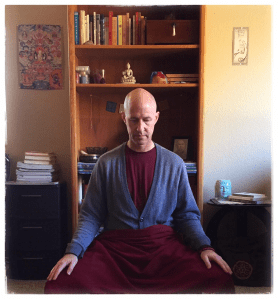
As a Buddhist (though one does NOT need to be Buddhist), as a meditator for the past 9 years, and as a meditation instructor I suggest and stand behind (…or is it sit behind) a regular meditation practice, as a beneficial support to self-care, so that one can also care for others.

A friend of mine recently asked me to share information about meditation practice with others in a post, because she has seen what many of us have seen – people exhausted and diminished by a deluge of negativity and overwhelming changes from those in power, pulling the ground out from under us.  She felt it would be a benefit and I do as well.

A note regarding meditation practice.  It isn’t a quick fix.  This may be disappointing, but the goal isn’t to attain some blissful or peaceful state (but what’s wrong with that?!).  When we practice meditation, we are practicing to be present in this moment – our mind and body together in one place – no matter the situation or what we are feeling.  In this way, with consistent practice, our hearts begin to naturally open and build a capacity to be with life as it is, without immediately reacting to it.  We are making space and in that space, we have the ability to choose our words and actions thereby benefitting the world, rather than adding to its suffering.  A short period of sitting every day is more beneficial than a long period of sitting once a week.  Don’t be discouraged.  After 9 years of meditating, I have noticed growth in my capacity to be with life and have seen my heart open more and more.  I wouldn’t have sought out instruction to be a teacher, if this weren’t the case.  And it is humbling, because other than committing to sitting and breathing, I have done nothing else to make this happen.  This is a nod to our true nature, which I believe is essentially good, that when we simply sit and allow the noise to fall away, to arise and then pass, the goodness of our hearts eventually comes forth.

I have recorded a brief 10-minute guided meditation as an introduction and instruction for you.

If you are new to meditation, I would also like to suggest my teacher’s book:  Start Here Now: An Open-Hearted Guide to the Path and Practice of Meditation by Susan Piver.
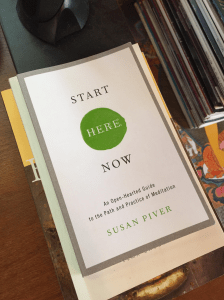
start-here-now

You may also want to connect with her teaching and instruction online at The Open Heart Project.

If you are interested in further exploration of the intersection of contemplative practice and social action/service, I’d also like to suggest The Road Home: A Contemporary Exploration of the Buddhist Path by Ethan Nichtern, who is also a teacher I admire and follow.  The last few chapters explore this more deeply.
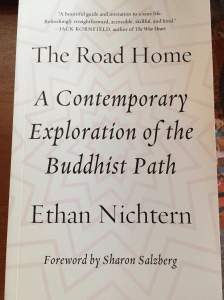
the-road-home

Ethan has also written a wonderful 7-Point Practice Plan for Engaged Mindfulness to assist in self-care as we care for others in this difficult time.

Wishing you all well as we journey together.

May all beings be happy and at ease.
May all beings be free from suffering.


~ j

01.30.17


forward, breath by breath…

Prior to the Christmas holiday, a dear friend reached out and commissioned some ensos.  These were to be particular ensos incorporating a semicolon, which was brought into focus as a simple of hope and journeying forward through the semicolon movement / Project Semicolon.

Here is a photo of one of the ensos I painted below, with an explanation of each element (the enso, the semicolon, and the phrase placed with it):


In Zen, the enso is a circle that is usually painted in one brushstroke, sometimes two, to express a moment when the mind is free to let the body create. It is considered abstract minimalist fine art. The enso is not about creating a “perfect” piece of art, rather the purpose is to authentically express “this” moment. The enso can symbolize our journey, the universe, enlightenment, awakening, life, and what I like to call “perfect imperfection.”


The semicolon (as expressed by Project Semicolon), “…is to restore hope and confidence in people who are troubled by addiction, depression, self-harm, and suicide. The semicolon symbolizes that the difficulties they face are not the end but a new beginning. A semicolon is used when an author could’ve chosen to end their sentence, but chose not to. The author is you and the sentence is your life.”


The mantra/phrase, “It’s just one breath”, is a phrase I’ve heard the meditation and Buddhist teacher Sharon Salzberg use often.  I have often incorporated this mantra into my meditation practice from time to time. When life or situations can feel overwhelming, it can be a wonderful salve to bring oneself back to this present moment, one breath at a time, remembering that “it’s just one breath.”  I thought this phrase made for a beneficial pairing with the semicolon and the enso.


~j


*Please note: Although meditation can be a beneficial and fruitful companion to professional medical or therapeutic help, it is not a substitution for these in the case of severe or clinical depression. It is best to seek professional advice when incorporating a meditation practice.

sharing the practice…


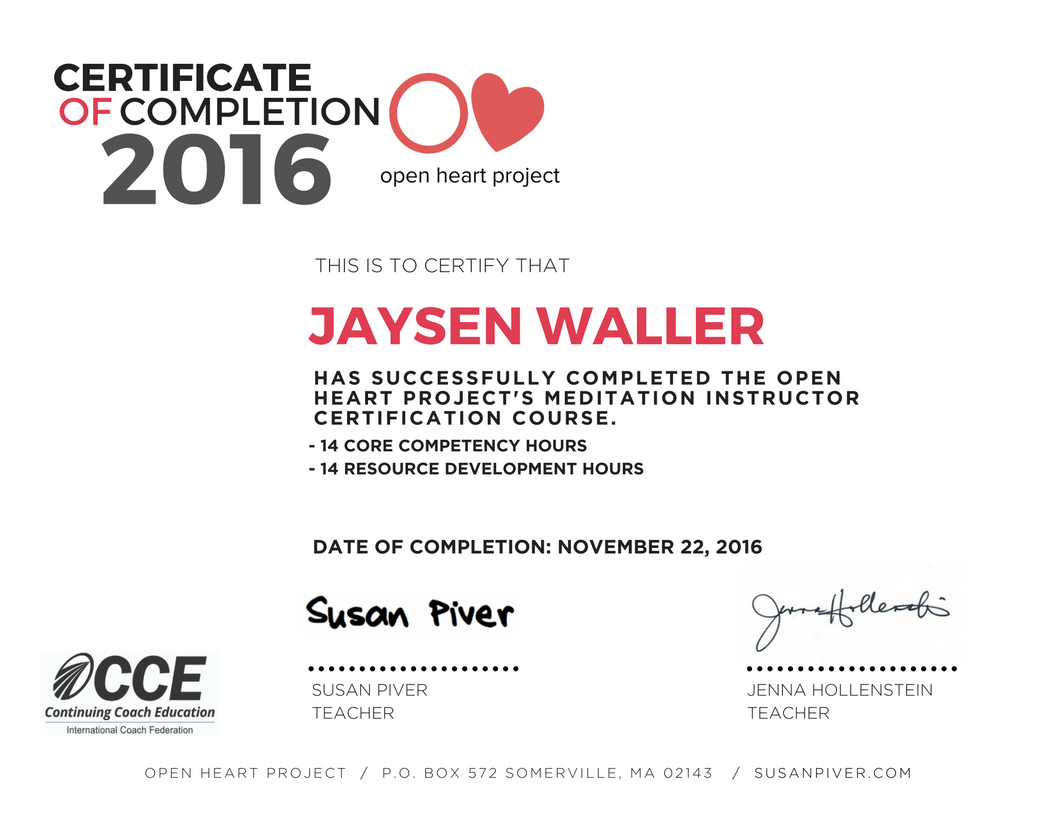
In 2008, I began a regular meditation practice after reading the book Calming The Fearful Mind: A Zen Response To Terrorism by Thich Nhat Hanh. It wasn’t that my mind was especially fearful, no more than any other person I suppose, but fear seemed and still seems to be very present in the world. And along with fear, all the other emotions that we either try to avoid, react from, or attach to. I wanted to learn to work with my mind and heart – with all of what is there, the fear, the anger, the sadness, the joy, the attachment. Although the willingness to be with what is – even if uncomfortable – is a courageous act, it also feels like a necessary act. something needed to help foster and maintain a sane balance in a beautiful world that can sometimes seem the opposite.At the beginning of 2016, with so much fear, anger, and negativity, I made a personal vow to work towards that which is healing. Part of this vow was to more fully invest in my meditation practice, devote my art and writing towards this aspiration, and to seek the path of being a teacher of meditation. An opportunity arose with a teacher I had long admired and followed, Susan Piver. Susan is from a lineage of Tibetan Buddhism, called Shambhala, which I deeply admire and respect. Though, to be clear, one does not have to be Buddhist to participate, practice, or teach meditation. The opportunity Susan was offering through her Open Heart Project, was unique and fit within where my life is presently. The practice of Shamatha (Sanskrit for “calm abiding”) has become my core daily practice and the practice I am now authorized to teach.

I cannot adequately express my gratitude or how amazing the past 9 weeks of training have been with Susan, and Jenna Hollenstein who co-taught. Their generosity of heart, the knowledge and wisdom imparted to us, and the gentleness of this practice transmitted to us has been a gift. I made friends from around the world that I will now be connected with and the practice I love and is a refuge has deepened. I am humbled, honored and grateful to share this with others. Bows of gratitude to both Susan and Jenna, along Michele Gare who was the magic behind the scenes at The Open Heart Project.
~j

all included, all of it…


Peace isn’t an experience free of challenges, free of rough, and smooth – it’s an experience that’s expansive enough to include all that arises without feeling threatened.
~

Pema Chödrön

#peace #capacity #expansive #allofit #allincluded #meditation #Shambhala #Buddhism #PemaChodron #wisdom #JMWart #dove #light